%20(3200%20x%20920%20px)-3.png)
Why Floor Plans Matter More Than Finishes + the Cost of Getting it Wrong
Updated: Aug 18
One Designer’s Perspective
When people begin building or remodeling, the conversation almost always starts with finishes.
What color cabinets?
What countertop?
What tile?
What hardware?
Finishes are exciting.
They’re visual.
They’re tangible.
They photograph beautifully.
But here is the truth — and it may not be the glamorous part:
Floor plans matter more.
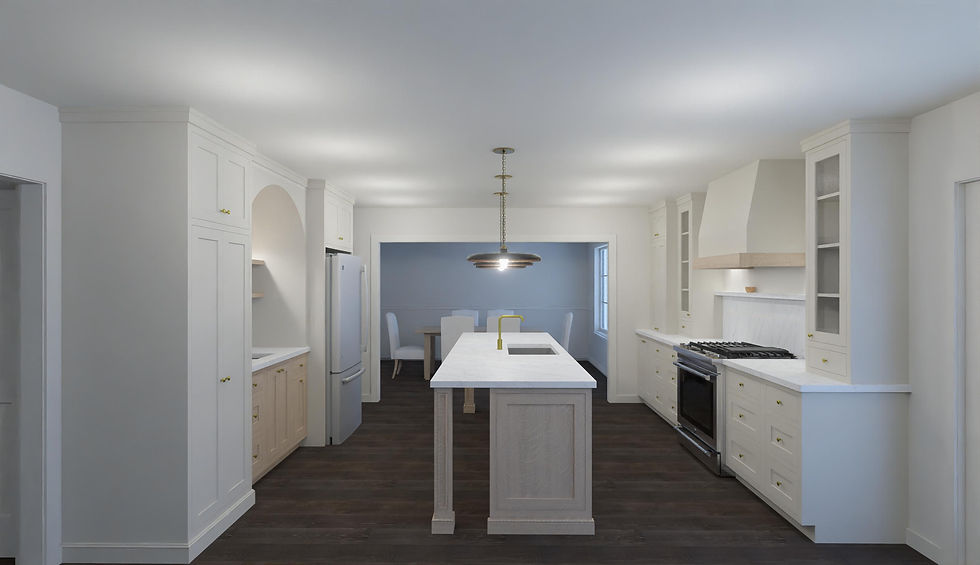
A floor plan dictates the way a home lives. It determines line of sight, ease of movement, circulation paths, and how spaces relate to one another. It shapes traffic flow through the kitchen on a busy morning, the way guests enter and gather, and whether a hallway feels intuitive or awkward.
Long after cabinet colors have been changed and light fixtures updated, the layout remains. There is a cost to getting the floor plan wrong. Lets discuss why.
OUR HOUSE ON A HILL PROJECT: 3D RENDERING OF THE NEW FLOOR PLAN
Design Is More Than Decoration
There is a persistent misconception that interior designers are brought in to "make things pretty." And while aesthetics are certainly part of the work, they are only one layer of it.
Accredited interior design programs and professional standards emphasize space planning, human behavior, ergonomics, building codes, and circulation long before finishes are ever selected.
Designers are trained to think structurally about how a space functions — not simply how it looks.
Decorating enhances a room.
Design organizes how it lives.
A well-trained designer spends significant time studying floor plans — adjusting proportions, evaluating adjacencies, ensuring rooms are appropriately scaled, and refining how people move through the home. Kitchens are laid out with intention. Sightlines are considered. Storage is accounted for. Furniture placement is anticipated before drywall is ever installed.
Because if the layout is wrong, no amount of marble can fix it.
The Cost of Getting your Floor Plan Wrong
When a floor plan doesn’t work, the frustration is subtle but constant.
Traffic bottlenecks form in kitchens.
Furniture floats awkwardly.
Walls block light.
Rooms feel slightly too small or unnecessarily oversized.
You may not always know why a home feels unsettled — but often, it’s the layout.
And unlike finishes, layouts are expensive to correct.
You can repaint cabinets.
You can swap lighting.
You cannot easily move walls, rework structural openings, or redesign circulation after construction is complete.
Building or remodeling without careful spatial planning can lead to some of the most costly and regrettable mistakes homeowners make.

The Balance Between Theory and Real Life
Of course, designing a floor plan is not about imposing one "correct" way to live. Every family moves differently through their home. Every household has its own rhythms.
There are times when my preferred layout differs from how a client naturally uses a space. That tension is part of the work — balancing best practices in flow and proportion with the realities of how you live.
Good design is not rigid.
It is responsive.
But it is intentional.

Finishes Are the Jewelry
I love finishes. I love selecting marble, choosing cabinet colors, layering hardware, adjusting lighting heights, and yes — I love a wallpapered room.
But finishes are the jewelry of a home.
The floor plan is the skeleton.
You live in your layout.You look at your finishes.
When construction begins without thoughtful planning, applying beautiful finishes to a flawed layout is like building on a weak foundation. It may look impressive at first glance, but the underlying frustration lingers.

Begin With the Plan
If you are building new or undertaking a significant remodel, bring a designer in before construction begins. Taking your time and planning projects early on, protects you from irreversible mistakes and ensures that your investment supports the way you actually live.
Because a home that flows well feels calm.
It feels intuitive.
It feels expensive — even when the finishes are restrained.
And when the layout works, everything layered on top of it becomes even more beautiful.


Comments